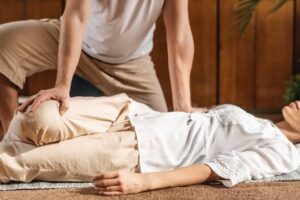
S H I A T S U, T H E N E R V O U S S Y S T E M & M e d i t a t i o n
BY KEN MCLEAN
Shiatsu as a practice embodies all the wonderful benefits that meditation brings.
The saying “when two people gather in my name, there I am” describes when two people really connect in a centred way then a third force is activated, an inspirational nourishment, a form of ki energy.
When we unify ourself and give treatments from this centred state, not only does the receiver benefit but also the practitioner is nourished deeply. In this way Shiatsu becomes a form of spiritual or Ki development for the practitioner. This activation of an inspirational energy occurs more strongly through interaction than when doing by ourselves. The word ‘musubi’, means unification, but also much more. Musubi also means tying the knot or marriage. When yin and yang combine — musu, a third force is born — bi. More than just a concept musubi is an expression on a physical level, it describes the gathering of energy to centre. In Shiatsu there is a way of applying pressure that is unique to this modality. In Japanese cooking, the rice ball is also called musubi, if the rice is too wet it won’t hold together, neither if it is too dry. When the balance of wet and dry (yin and yang) is just right our moulding and kneading of the rice to centre allows the rice ball to keep its shape. Ultimately, in giving treatments through practice and experience, we can enter into a flow state, to find the rhythm and pressure that is most suitable for our client. Some of the things that help this process include moving from our centre, maintaining correct posture, using whole body movement from our waist, and how to sink our pressure to the chord. The chord is where the meridian meets the physical body, under the surface of the skin. If we do this well, there is a certain feeling that is both pleasant and deeply nourishing.
If we press too hard or too sharply, the orthosympathetic nervous system is activated and inner resistance is created.
The orthosympathetic and parasympathetic nervous systems are harmonised in Shiatsu.
In the following writing, for convenience I will refer to the orthosympathetic as the outer nervous system and the parasympathetic as the inner.
Often stress is held in the outer nervous system, and so cannot receive the calming and relaxing guidance of the inner nervous system.
Also the outer nervous system is responsible for the fight and flight response. So if our Shiatsu technique is too direct or sharp, it causes the outer nervous system to go on high alert. As we refine our technique and centred movement, as well as learn how to sink our bodyweight smoothly to the chord, then the outer nervous system relaxes, and the inner nervous system activates. This wakes up the deeper Ki in the body as the meridian and energetic levels are deeply connected to the inner most aspect of our nervous system, sometimes referred as the limbic system. All the systems and organs in the body are in dialogue, most of the communication is not intimate or connected enough. Through cultivated Shiatsu, the outer and inner nervous systems become closer and closer in their dialogue, returning to the state of original oneness. This results in the dissolving of stress and tension, and supports the even
spread of energy through the whole body. As practitioners, for this to occur in our treatments, we firstly need to enter into this deep state in ourselves before it can occur within others. This is the practice of Shiatsu as Do or Tao, the way of cultivating our deepest Self. The practical way of doing this is through the refinement of correct technique, movement, pressure and mind. This includes the art of blending and harmonising with the unique qualities of our clients’ body and energy — mikoto ha.
As we do this well, and as the outer nervous system relaxes and the inner nervous system awakens, certain meridians come to the surface and ask to be treated along with master points (tsubos), that are unique to that person’s condition.
One of the pitfalls of visual and Hara diagnosis is the imposition of a judgement on the person before we have deeply blended and harmonised with them to create a state of non-separation. This judgement can cause the meridian body to withdraw deeper rather, than come to the surface to be treated.
Just like when we meet someone at the coffee shop, we start with light conversation, and as our connection warms up, we relax together and enjoy each other’s company, and a state of trust is created. Then a deeper issue or concern may be shared with ease. Similarly when giving Shiatsu as a meditational practice, as we blend and connect to the chord, a release of tension occurs, the meridian and the physical body harmonises and energetic trust is formed. This allows the master points that are unique to that person to come forward to be treated.
Master points:
Master points are tsubos (energy points) unique to that person and what they are going through. There are universal master points, which are points that are common to most human beings, such as points that are sore in calf or shoulder points etc. Individual master points are different as they are unique to the individual condition.
The conscious mind, or everyday mind, won’t find them as explained earlier. To find them, is to allow them to find you through the practice of Shiatsu, as meditation and interactive harmonisation (aiki). When we do this these points come to us, and then through holding a certain way, energetic patterns are moved and positive processes are activated towards deep wellbeing on all levels: physically, mentally, emotionally and spiritually.
Shiatsu practice is such a wonderful healing modality, and a rich and endlessly fascinating way of nourishing and developing our deepest Self.
Each treatment provides an opportunity, to enter into this interactive energy meditation, where we flow and harmonise with the energy of life, as expressed through each person we treat.
Ken McLean is the founding director of Shin Sen Dojo in Sydney. He teaches and practices Ki Shiatsu, Aikido, Ki Energy Cultivation and Macrobiotics.
www.shinsendojo.com.au phone: 0414 614 169
Source: From Pointers Winter 2026 – STAA
JOURNAL OF THE SHIATSU THERAPY ASSOCIATION OF AUSTRALIA Inc. ISSN 1332-7394
Pointers:
Journal of the Shiatsu Therapy Association of Australia Inc. ISSN 1332-7394. Layout & formatting: Jessica Baker-Editing: Belinda McIntosh and Linda Rago-Cover photo by Canva images.
Editorial policy:
We reserve the right to edit material when required. This journal is dedicated to the study
of shiatsu and the furtherance of the profession. Articles appearing herein may be reproduced in international non-profit shiatsu publications with the permission of the author. The views presented in articles or advertising in Pointers journal are not necessarily shared by the editor, publisher or the Shiatsu Therapy Association of Australia Inc.
Disclaimer:
The Shiatsu Therapy Association of Australia Inc. assumes no responsibility or liability for any injury, loss or damage incurred as a result of any use or reliance upon the information and material contained within this journal. While considerable care has been taken in preparing the information and materials displayed in this journal, STAA is unable to provide any warranty concerning the accuracy or completeness of any information contained herein.
Next edition:
Pointers next edition will be in Summer 2026. The deadline for contributions is 1 November 2026. If you have any ideas or comments or would like to discuss a potential article or advertising, please contact: enquiries@staa.org.au
Therapy Association of Australia – PO Box PO Box 22 Chirnside Park Victoria 3116
ph : 0411 273 270 www.enquiries@staa.org.au www.staa.org.au
National Council 2026